
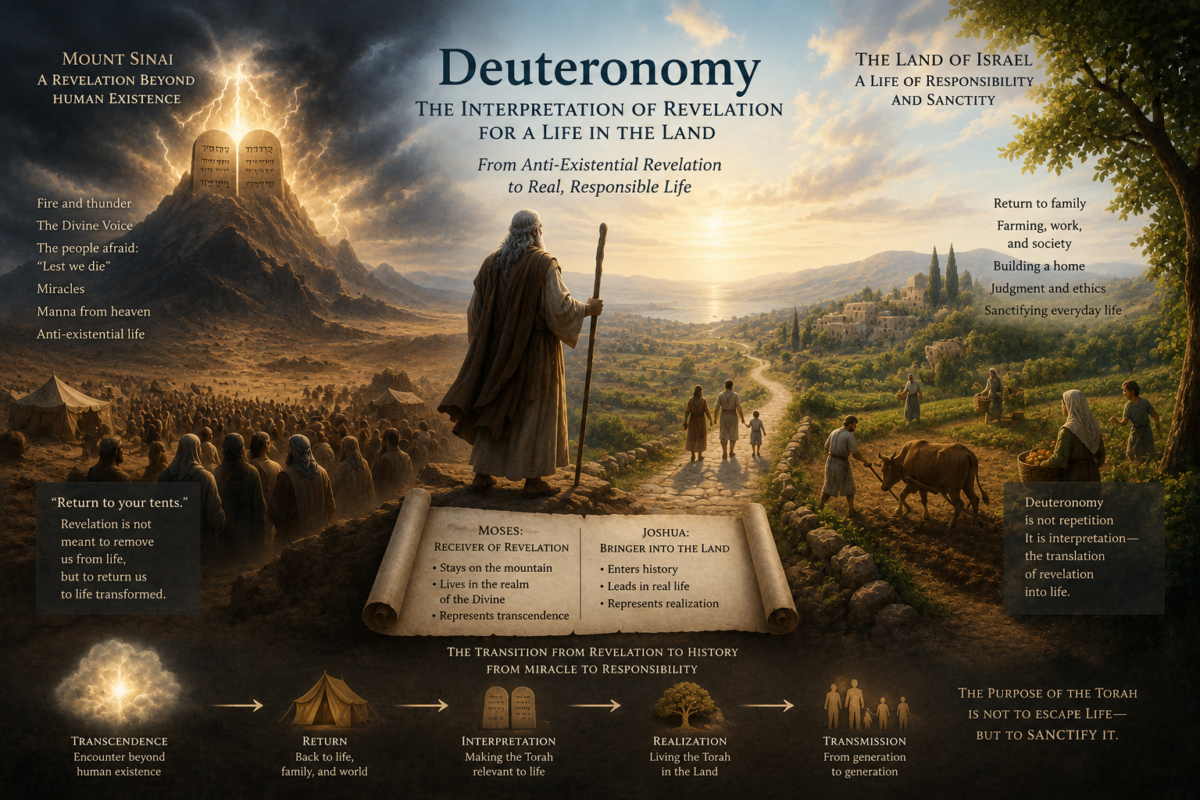
The Book of Deuteronomy is unlike any other book in the Torah. Rather than recounting new events, it consists almost entirely of Moses’ final address to Israel before his death and before the nation’s entry into the Promised Land. This raises an important question: Why does Moses repeat the Torah? What is the purpose of this final speech?
The essay proposes that the answer lies in the opening verses of Deuteronomy themselves. Moses begins by stating that he “undertook to explain this Torah.” This “explanation” is not merely a repetition of previous teachings. Rather, it represents a profound reinterpretation of the entire wilderness experience in preparation for a radically different mode of existence.
The central thesis is that the Torah given in the wilderness was received within an anti-existential reality—a mode of life intentionally detached from ordinary human existence. Israel lived by miracles: manna descended from heaven, clothing never wore out, and the nation’s survival depended directly upon divine intervention. Above all, the revelation at Mount Sinai constituted an encounter that transcended the normal conditions of human life. The biblical imagery of consuming fire expresses precisely this point: such a revelation cannot become humanity’s permanent condition.
The people’s own response at Sinai reflects this paradox. They long for closeness to God, yet simultaneously fear that continued exposure to the divine presence will destroy them. Their plea—”lest we die”—reveals that revelation, in its purest form, is inherently incompatible with ordinary human existence.
God’s response therefore becomes decisive: “Return to your tents.”
These words are far more than practical instructions following the revelation. They establish one of the Torah’s deepest theological principles. The purpose of revelation is not to remove humanity from life, but to return human beings to life transformed by revelation. Moses, uniquely, remains on the mountain. Israel must return to family life, society, labor, and history.
The essay argues that this command serves as the conceptual key for understanding the entire Book of Deuteronomy.
For forty years Israel continued to inhabit a miraculous world that, in many respects, prolonged the experience of Sinai. Their repeated complaints in the wilderness reflected more than physical discomfort. They expressed the existential tension of living within a reality suspended between miracle and ordinary existence.
Now, standing on the threshold of the Land of Israel, Moses announces that the wilderness period must finally come to its intended conclusion.
In this light, Deuteronomy is not simply a review of previous events. It is an act of interpretation. Moses teaches Israel how to carry the memory of Sinai into ordinary historical existence.
The Land of Israel represents not merely a geographical destination but the restoration of genuine human life. Agriculture, family, political society, economic responsibility, and historical continuity become the very arenas in which revelation is meant to be realized.
Consequently, the Torah is transformed from an abstract revelation into a living guide for concrete existence.
The essay therefore understands Moses’ “explanation of the Torah” as an act of adaptation: not changing the Torah itself, but interpreting it so that its transcendent meaning can become fully embodied within earthly life.
This perspective also sheds new light on the relationship between Moses and Joshua. Moses belongs to the world of direct revelation. Joshua belongs to the world of historical realization. The transition from one leader to the other symbolizes the transition from transcendence to history.
Seen from this perspective, Deuteronomy may also be understood as the prototype of the Oral Torah. The Oral Torah does not replace revelation; it interprets, applies, and translates revelation into lived reality. Moses becomes not only the receiver of divine law but its first great interpreter.
Throughout Deuteronomy one recurring theme emerges: true life is not found by escaping the world but by sanctifying it. Again and again Moses links obedience to the Torah with life itself. The wilderness served as preparation; the Land is where authentic life begins.
This also explains Moses’ repeated insistence that Israel must never forget Sinai. The revelation is not meant to remain a distant historical memory or a miraculous event detached from ordinary existence. Rather, it must become a living source of moral and spiritual consciousness within everyday life, passed faithfully from generation to generation.
The essay concludes that the movement from wilderness to the Land reflects one of the Torah’s deepest theological patterns: the movement from transcendence toward history, from miracle toward responsibility, and from extraordinary revelation toward the sanctification of ordinary human existence.
In this sense, Deuteronomy is not simply the Torah’s final speech. It is its first sustained interpretation—a guide for translating revelation into life.