
Part I
This week marks the eighty-fifth anniversary of one of thegreatest tragedies ever to befall the world of Torah scholarship.
On the twentieth of Tammuz, 5701 (1941), nearly the entire student body of the famed Telz Yeshiva, together with its rabbinic leadership and faculty, was murdered in cold blood by the Nazis. The sequence of events unfolded with devastating speed. On the first day of Tammuz, German forces entered the Lithuanian town of Telz. The following day, they began implementing their campaign of destruction. The entire Jewish population was expelled to the nearby settlement of Rainiai, where they were confined to a labor camp. Only a few weeks later, on the bitter day of the twentieth of Tammuz, the massacre was carried out.
Among those murdered was Rabbi Avraham Yitzchak Bloch, together with the entire senior leadership of the yeshiva, its preparatory academy, and virtually every member of its distinguished faculty.
With a single murderous blow, one of the most illustrious institutions in the history of Lithuanian Torah scholarship was almost entirely extinguished.
Founded in 1875, the Telz Yeshiva had become far more than an academy of advanced Talmudic learning. It cultivated a distinctive intellectual tradition, combining rigorous analytical study with profound ethical and philosophical reflection. Its influence helped shape the very character of Lithuanian Torah scholarship and Jewish moral thought.
Within the immeasurable catastrophe of the Holocaust, the destruction of a single yeshiva may appear almost insignificant. Yet within the collective memory of the Torah world, the annihilation of Telz occupies a singular place. Few yeshivot disappeared so completely in the course of a single day. Within hours, a monumental enterprise of Torah learning, built over generations, seemed to vanish from history.
For one terrifying moment, it appeared as though the ancient Talmudic assurance—“The chain of Torah academies has never ceased among our ancestors”—had finally been broken. It seemed conceivable that the voice of Torah itself might be silenced forever.
Yet precisely here, the words of Israel’s national poet, Hayim Nahman Bialik, whose yahrzeit is also commemorated this week, acquire extraordinary resonance:
There are still forgotten towns scattered throughout the exile,
Where our ancient flame continues to smolder in secret.
Our God has preserved a great remnant,
A glowing ember buried beneath the ashes,
Like brands rescued from the fire, still quietly burning.
Indeed, even after the greatest catastrophe our people had ever known, the ember continued to glow beneath the ashes.
Those few survivors became, in retrospect, the remnant preserved by Divine providence—not merely to survive, but to rekindle the flame of Torah and Jewish thought for generations to come.
The story of Telz itself illustrates this truth with remarkable clarity.
In 1940, only months before the destruction of Lithuanian Jewry, two senior members of the Telz faculty succeeded in leaving Lithuania under permits issued by the Soviet authorities. They were Rabbi Eliyahu Meir Bloch and his brother-in-law Rabbi Mordechai Katz, both eminent roshei yeshiva.
Their purpose in traveling to the United States was not personal escape. Their singular mission was to save the yeshiva—to transplant it to safety before the approaching inferno of destruction consumed it.
The astonishing fact is that already in the autumn of 1941, only months after their arrival—and before they had even learned the full extent of Telz’s destruction—they began laying the foundations for a new yeshiva in America.
Only in 1945 did three survivors of the massacre finally reach Cleveland, where they joined Rabbis Bloch and Katz together with seven young American students. Thus the Telz Yeshiva was formally reborn, preserving not only its name but also its intellectual and spiritual identity, despite its radically different geographical setting.
That institution, now located in Wickliffe, Ohio, continues to flourish to this very day.
Among its later leaders were Rabbis Isaac Ausband and Chaim Stein, themselves survivors of Telz. Together with sixteen students, they had fled Lithuania only days before the German invasion, escaping eastward into Soviet territory. Only eight members of that group survived the war, several of whom eventually became pillars of the reestablished Telz Yeshiva in America.
The renewed Telz became one of the most influential yeshivot in the United States and one of the principal foundations upon which the postwar renaissance of the Torah world was built.
The historical importance of recounting this story scarcely requires justification. “Remember the days of old; consider the years of every generation.” Yet I have chosen to revisit it דווקא now, at a moment when the question of military service for yeshiva students stands at the center of Israel’s public debate.
This is undeniably a profound and consequential issue. Few can remain indifferent to the moral challenge expressed in Moses’ enduring question:
“Shall your brothers go to war while you remain here?” (Numbers 32:6)
Yet at the same time, it is equally important to understand the extraordinary historical ethos that binds today’s yeshiva world to the one that was almost entirely obliterated.
Telz is only one example. The same could be said of Ponovezh, Mir, Slabodka, Hebron, and many others—institutions that continue to form the living backbone of the contemporary Torah world.
Modern yeshivot did not simply inherit an educational tradition. In a very literal sense, they arose upon the ruins of a civilization that disappeared almost overnight.
This is not merely institutional continuity. It is the continuation of a historical consciousness.
To those who did not grow up within that world, this may sound abstract, perhaps even romanticized. Yet for those formed within it, that consciousness is deeply tangible. It manifests itself as an unbroken chain of transmission—a living awareness that stretches backward across generations.
It is true that many contemporary yeshiva students know little about the original Telz Yeshiva or the intellectual innovations of Rabbi Yosef Yehuda Leib Bloch. Nevertheless, the institutional world they inhabit possesses an inner life and memory of its own.
It is sustained by an ethos that emerged from catastrophe, reconstruction, and continuity.
Perhaps that is why many within the yeshiva world experience present-day challenges not merely as political disagreements, but as existential threats to a centuries-old tree whose roots descend into one of the deepest traumas in Jewish history.
Let me be clear: this is not intended as an apologetic defense.
Rather, it is an attempt to provide a broader historical framework—to suggest that the contemporary debate cannot be understood solely in terms of military service or social policy.
Behind it lies an entire civilization shaped by memory, continuity, and a profound sense of historical responsibility.
Part II
When Words Find Their Way Home
“For a bird of the air shall carry the voice, and that which has wings shall tell the matter.”
(Ecclesiastes 10:20)
Last Sunday evening I sat down to write the reflections that comprise the first part of this essay—a tribute to the memory of the Telz Yeshiva and the remarkable story of its rebirth after the Holocaust.
For anyone familiar with my routine, there was nothing unusual about it. For years I have written regularly on historical, philosophical, and contemporary themes, attempting to uncover unexpected connections between them. Yet publishing always carries an element of mystery. One never truly knows where one’s words will travel, whose heart they may reach, or what hidden echoes they may awaken.
I must confess that, as I wrote and published those reflections, I could never have imagined the extraordinary response they would generate.
Within hours I began receiving an overwhelming stream of messages—comments, corrections, additions, personal testimonies, and, naturally, a number of thoughtful disagreements. Something in that story, or perhaps in the way it was told, seemed to unlock deeply buried memories and emotions in an astonishing variety of people.
For anyone afflicted—as I gladly admit I am—with the irresistible impulse to write, there is hardly a greater privilege.
Every writer hopes, in one way or another, to touch another human being; to discover precisely those words capable of crossing invisible boundaries of geography, culture, and experience. Occasionally, almost miraculously, that hope is fulfilled.
This was one of those rare occasions.
Yet what moved me even more was an encounter that followed.
Among those who read the essay was Mrs. Tziporah Weinberg, the daughter of Rabbi Chaim Stein זצ”ל, one of the towering leaders of the reestablished Telz Yeshiva in America.
As I briefly noted in the previous essay, Rabbi Stein himself had been one of the outstanding young scholars of the original Telz Yeshiva in Lithuania. He belonged to that tiny remnant who escaped only days before the German invasion, while virtually his entire family, together with the community and the yeshiva that had shaped his life, were murdered.
Remarkably, my article reached Mrs. Weinberg almost immediately.
With admirable determination she obtained my telephone number and called me the very next morning.
She thanked me warmly for writing about Telz, but more importantly, she wished to tell me something of her father’s story.
It is difficult to describe the depth of emotion in her voice.
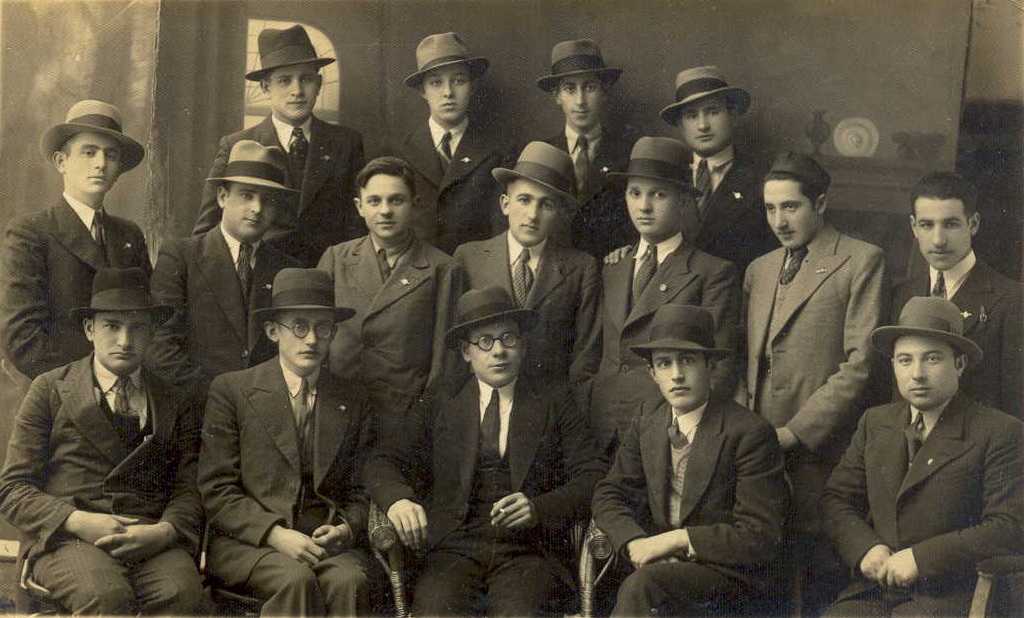
The few paragraphs I had written—together with an old photograph accompanying the article, in which she believed there was a real possibility that her father himself appeared among the students—had touched something profoundly personal.
For her, the story of Telz was not history.
It was memory.
Living memory.
The story of her father, of his teachers, of his murdered family, and of the yeshiva that rose once again from destruction remained, after all these decades, a living volcano of grief, gratitude, and faith.
Listening to her, I found myself deeply moved.
Quite unexpectedly, I realized that I had been drawn into a living chain of memory connecting the present with one of the darkest chapters in Jewish history.
Only then did I fully appreciate how words, once released into the public sphere, can acquire a life entirely their own.
They travel.
They connect strangers.
They awaken forgotten histories.
They become, in a sense, acts of memory themselves.
Mrs. Weinberg was not content merely to speak over the telephone.
She immediately invited me to her home in Jerusalem.
Her purpose was simple.
She wished to present me with a gift.
It was a copy of From Telz to Telz, a remarkable volume compiled from the wartime diaries of her father, Rabbi Chaim Stein.
These diaries, written in six notebooks between 1940 and 1945, constitute an extraordinary historical document.
Far more than a memoir, they are the real-time testimony of a young Torah scholar witnessing, recording, and enduring one of the greatest catastrophes in Jewish history.
Less than twenty-four hours after publishing my essay, I found myself sitting in her home, holding that remarkable book in my hands.
Since then, I have scarcely been able to put it down.
Its pages contain not merely historical information, but the inner world of a human being who succeeded in preserving astonishing spiritual clarity while surrounded by unimaginable darkness.
The descriptions are heartbreaking.
Yet they are equally remarkable for their lucidity, intellectual honesty, and unwavering faith.
As I continued reading Rabbi Stein’s journals, one thought returned to me again and again.
The magnificent Telz Yeshiva had indeed been almost entirely obliterated in a single act of unimaginable violence. Yet the handful of survivors it left behind proved to be extraordinary—not in number, but in stature.
They became the living testimony that the human spirit, fashioned in the Divine image, possesses reserves of resilience almost beyond comprehension.
Rabbi Chaim Stein was one such figure.
His life embodied not merely survival, but spiritual reconstruction.
It seemed to me that the true legacy of Telz did not reside solely in the institution that was rebuilt in Cleveland. It also lived in individuals like Rabbi Stein, whose very character became a continuation of the yeshiva that the Nazis believed they had erased.
Allow me to share one brief passage from his wartime diary.
The entry was written shortly after the High Holy Days of 5702 (October 1941), scarcely four months after the destruction of the Jewish community of Telz and the murder of his parents and much of his family.
He writes:
“When the festivals had passed, we were overwhelmed with feelings of gratitude to the Almighty that we had merited to observe every one of them according to all their laws and details. In my remarks I said that through this we perceive a ray of God’s countenance, even amidst the concealment that now envelops the world. This small illumination granted to us through the privilege of fulfilling the commandments of the festivals reveals that all His dealings with us remain under Divine Providence, under the watchful eye of God over those who fear Him.
I illustrated this through Joseph. When he was taken to Egypt to be sold as a slave, the Ishmaelites happened to be carrying fragrant spices rather than the foul-smelling merchandise usually transported. The Sages ask: what difference could such a small comfort possibly make to someone being sold into slavery? I once heard Rabbi Mordechai Pogromansky explain that its true purpose was to show Joseph that even in the midst of Divine concealment, God’s providence remained with him. The fragrance itself became a sign that the light of God’s presence had not departed.
So it is with us. Through the miraculous opportunity to observe the festivals and fulfill their commandments, we too have glimpsed a ray of that Divine light. Our hope is strengthened that everything, ultimately, is for our good, and that salvation will yet come speedily. Beyond everything else, the very experience of fulfilling these commandments is itself of immeasurable value.”
There is much that could be said about these extraordinary words.
They are a profound meditation on providence, hope, and religious consciousness under conditions that defy ordinary human comprehension.
Yet I suspect that any attempt to explain them at length would only diminish their power.
Some texts demand commentary.
Others ask simply to be heard.
This passage belongs unmistakably to the latter.
May these words stand as a tribute to the towering memory of Rabbi Chaim Stein זצ”ל—one of those “brands plucked from the fire” who left future generations an incomparable testimony of faith.
His journals are far more than a historical record.
They are a theological document.
A human document.
A testament to the astonishing capacity of the Jewish spirit to preserve hope when every external reason for hope has disappeared.
I can only encourage every serious student of Jewish history, theology, and the moral resilience of the human soul to seek out this remarkable work.
It is, quite simply, an extraordinary treasure.